Brahma Blogs

This team blog is designed to allow a group of friends who have known each other for 20+ years to share their thoughts on culture, politics, religion, relationships, etc.

Wednesday, July 27, 2005

Reunion Photo


Here's the only picture I got of us at the reunion. I didn't take any pictures at Walter's. If you were one of the ones that did, please post them.

Fighting Fire With Fire?

I'm a week late or so on this story but it seems to still be resonating among my journalism colleagues, so I thought I would bring it up for debate here.
A U.S. Representative from Colorado, Tom Tancredo, told a talk radio host that the U.S. government should think about threatening leading Islamic clerics with the bombing of holy sites like Mecca to persuade them to do more to stop the extremists among their ranks who are the source of so many terrorist attacks around the world.
I don't think he was saying that we would actually bomb those sites, but I think he was trying to make the point that terror groups have no home base, so you have to go after something that is precious to the religious or organizational leaders who can sway their opionions.
What do you think of that approach?

Tuesday, July 26, 2005

Reunion

Although I missed the 10th high-school reunion, I did just attend the 20th. There I saw Meredith, Michele, Lila, Walter, Doug, Nate, Ed (the Red), a few others that I came to recognize, and, of course, spouses and children. I did not take pictures, but at least Michele, Lila, and---at a Sunday afternoon gathering at her house---Walter's mother did. I even did a few back flips, one of which was caught by Po on video.

Michele's daughter (Thia, I think) has a bizarre and entertaining method of locomotion, the one-legged scoot. My oldest, Kayleigh (who will be driving, with me in the passenger seat, a few weeks after our return to Colorado), used a hands-and-feet bear crawl in order to delay walking, about fourteen years ago. Still, I have also a seven-month-old, who will hopefully make her own way, a few months from now, across the frontier of walking.

As I feared, I was recognized by more persons than I recognized, but the pleasure of seeing old friends more than made up for the embarrassment of bad memory. The most interesting pattern in my opinion is that whereas every woman's appearance is largely unchanged from that of her graduation photograph, every man's appearance has changed almost beyond recognition. (And the latter is actually a good thing. :^)

Thursday, July 21, 2005

Good News/Bad News

I write this on the eve of the 20-Year Reunion weekend where hopefully Tom, Michele, Lila and a few others will be able to reconnect in San Antonio. I hope each one of them will give a report of their experiences there for those of us who couldn't go.
I wanted to catch you up on a few things and why I haven't posted here in a while.
First, the good news - Lark and Deline got married a few months ago in Vegas after a 13-year courtship. It was really sweet ceremony performed by an Elvis impersonator who was so good that I booked him for a national audience on the Today Show a few weeks later. Deline looked beautiful, Lark made it through the whole ceremony without tripping on anything and everyone wore Hawaiian shirts per the couple's request. It was a nice, small gathering of mostly family and a few friends. Very fun.
Now, the bad news.
Kyung and I are getting a divorce after 7 years of marriage. It was pretty public and pretty ugly and if you REALLY want to know the details, just google her name and you'll see all of it displayed in various newspapers and websites. It's too painful for me to talk about here, but basically we are separated and have already filed all of the papers. It will be official on December 12 because of a 6-month waiting period in California.
On a more positive note, I have been doing a lot of travelling for the Today Show from New York City to Paris for the Olympic Bid Announcement to Pamplona, Spain for the Running of the Bulls. It's been a very busy few months.
I will get busy posting some items here and hopefully give you guys a reason to login to the site every day.
Thanks to Tom for keeping the entries going over these last few months.
If you go to the reunion, please send pictures to me or put them on the blog for everyone to see.

Friday, July 15, 2005

Dust-Devil Tracks on Mars


According to an article at UniverseToday, dust devils on the surface of Mars during the summer could be quite annoying to an astronaut out in a space suit.

Wednesday, July 13, 2005

The Catholic Weirdo

In an article over at CatholicCulture.net, Peter Mirus explains why a Catholic appears so weird to the outsider. Here's an interesting quote:

I was aware at a young age that I had a mindset, due to my Catholic upbringing, that put me at odds with society and made me somewhat of a target to my peers. I can remember days when, at the age of 12, I was making a decent attempt at trying to explain life issues, saints, and the Eucharist to kids in my neighborhood. They, in turn, laughed at my ignorance of all matters relating to human relationships (i.e., sex) and modern culture (i.e., Van Halen) and therefore tried to expose me to as much sex and Van Halen as possible.

So there was a certain cultural exchange here. But due to the round-the-clock efforts of my parents to make sure my fallen nature didn’t get the better of me, I survived with my oddness intact.


I was certainly weird in high school.

Unlike Peter Mirus' appearance to his peers in high school, however, my appearance to you in high school was probably not nearly so odd as my appearance to you now. That's because I wasn't really Catholic in high school. I wasn't well catechized. I didn't know what the Church actually teaches. I did have a general desire to be good, but I wasn't particularly good at denying myself gratification from actions that are objectively evil.

I wish that I had been much weirder in high school.

Tuesday, July 12, 2005

The Return of the Space Shuttle

As the Space Shuttle's return to flight is imminent, it seems appropriate to remember what goes into a launch of the Shuttle. An old article about the software that controls the launch has some interesting words:

As the 120-ton space shuttle sits surrounded by almost 4 million pounds of rocket fuel, exhaling noxious fumes, visibly impatient to defy gravity, its on-board computers take command. Four identical machines, running identical software, pull information from thousands of sensors, make hundreds of milli-second decisions, vote on every decision, check with each other 250 times a second. A fifth computer, with different software, stands by to take control should the other four malfunction.

At T-minus 6.6 seconds, if the pressures, pumps, and temperatures are nominal, the computers give the order to light the shuttle main engines -- each of the three engines firing off precisely 160 milliseconds apart, tons of super-cooled liquid fuel pouring into combustion chambers, the ship rocking on its launch pad, held to the ground only by bolts. As the main engines come to one million pounds of thrust, their exhausts tighten into blue diamonds of flame.

Then and only then at T-minus zero seconds, if the computers are satisfied that the engines are running true, they give the order to light the solid rocket boosters. In less than one second, they achieve 6.6 million pounds of thrust. And at that exact same moment, the computers give the order for the explosive bolts to blow, and 4.5 million pounds of spacecraft lifts majestically off its launch pad.

Monday, July 11, 2005

The Laforge Look

Wednesday, July 06, 2005

Europe Rejects the Software Patent Directive!

Although the government's granting a patent for an invention may be good for stimulating innovation in some fields, a patent for an idea whose primary implementation is purely in software only stifles innovation.

Ideas are routinely invented, modified, and independently re-invented by writers of software, amateur and professional, all over the world. Moreover, the nature of software development is such that, in comparison with an industrial plant fabricating a physical product of equivalent complexity, the scale of investment in the software effort is orders of magnitude smaller. On the one hand, it is naturally much easier to innovate, to produce, and to distribute a useful piece of software than it is to do so for a useful physical product; on the other hand, it is the complexity of an invention that determines its liability to patent lawsuits. So, while it may be reasonable to expect a large company, with capital investment in a factory and transportation infrastructure, to license patents or else to defend itself with lawyers against patent lawsuits, it is unreasonable to expect a small company, whose software product is nevertheless of a complexity equivalent to that of the large company's physical product, to bear the same burden.

The software patent serves only the interests of two groups:
  • large, multinational corporations, each of whom uses its software patent portfolio for cross-licensing deals with other corporations so as to avoid the stifling effect on innovation that software patents would otherwise cause and

  • those relatively small companies, each of whom has as its only income the use of software patents to extort money from those who would try to innovate and to produce something useful.

Unfortunately, software patents have existed in the United States since 1981, when a court decision explicitly allowing them went largely unnoticed by the public. In Europe (except in the U.K.), however, there is not presently a bureaucratic mechanism for patenting an idea readily implemented in software. In fact, by the time the advocates for software patents starting pushing European institutions to provide such patents, the danger had (largely from experience in the United States) become apparent. The European free software community organized and led the campaign to oppose the establishment of software patents in Europe. After a long battle, it seems that a victory has been won today.

For a more detailed explanation of why software patents are evil, there is a speech given by Richard Stallman at Cambridge in 2002. There is also an article presenting a mathematical model of the adverse effect of patents in certain fields such a software.

Tuesday, July 05, 2005

A Centripetal Man in a Centrifugal Age

Denver's archbishop Charles Chaput (my archbishop!) recently wrote a reflection on the legacy of Pope John Paul II. It has some choice quotes, two of which occur in a single paragraph:

Critics also repeatedly and inaccurately described [John Paul II] as a "conservative" or a centralizer. These are misleading words. He was a centripetal man in a centrifugal age; a force for unity, integration, and renewal of mission in the Church at a time when the aftermath of the council threatened to fragment Catholic identity. The U.S. media's constant harping on issues like abortion, contraception, and women priests revealed far more about American parochialism and sexual disarray than it did about the real issues facing the global Church. In fact, media coverage of the Wojtyla pontificate seemed to become, in its later years, what one of my senior staffers called "a report on the giant by the dwarves."

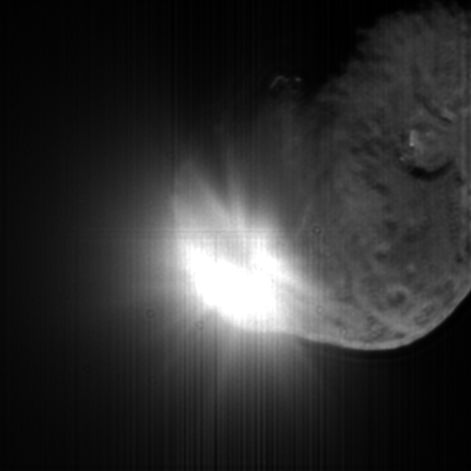
Impact!


This is good for business!

I work at Ball Aerospace, and, although I played only a small part in fixing a problem with the star camera on the Impactor spacecraft a couple of weeks ago for the Deep Impact program, I am happy to see that the DI team succeeded. The Deep Impact program, which just smashed a copper mass (inside the Impactor) into a comet, is the first program for which Ball Aerospace has ever built an interplanetary spacecraft. In this case, of course, it was really a pair of spacecraft: the Impactor and the Flyby.

Sunday, July 03, 2005

ITER: Hope for the Future


The International Thermonuclear Experimental Reactor (ITER) project is moving forward again, after almost two years of stalemate over where to build the reactor. Although ITER, which will be built in France and is scheduled to be operational by 2015, will not generate electricity, it is expected to produce substantially more energy than it consumes. ITER is expected to pave the way for the first commercial nuclear fusion power plants by mid-century.

Of course, every big project is associated with a lot of bureaucratic waste and some real technical problems. So it's not surprising that ITER has opponents. The U.S. even withdrew from the project at one point and then joined again a few years later. I must admit, however, that I am glad to see progress here, even if the current progress is only political. If we eventually figure out how to generate a substantial fraction of our electrical power from nuclear fusion, then we shall have served our descendants well.